
Lay it all out on the floor first — the SnowWind backcountry gear list
In this article7 sections
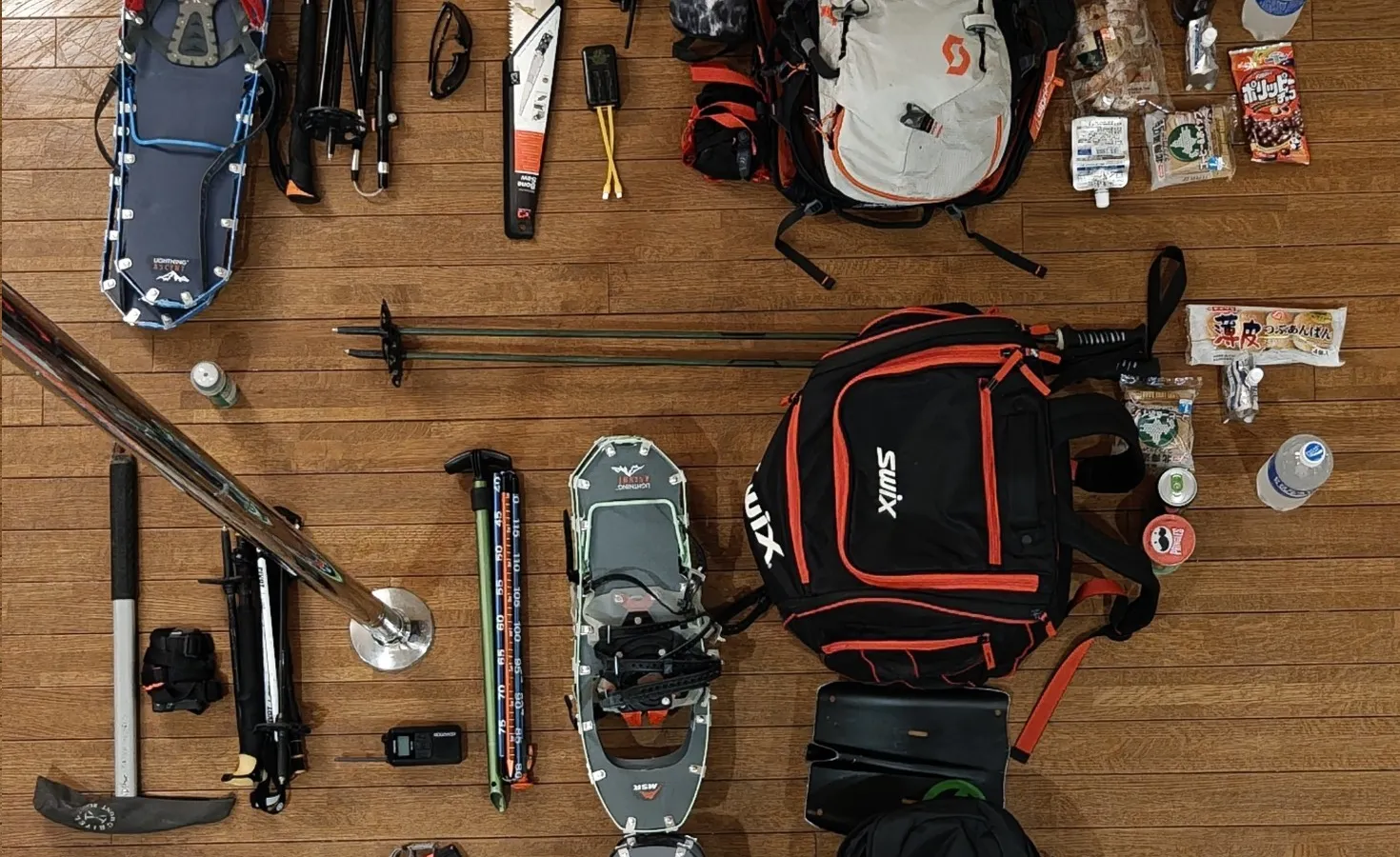
This is what our floor looks like the night before every departure.
Not for the photo. Taking every item out of the pack, laying it out and going through it piece by piece is the cheapest insurance in backcountry travel — whether the batteries are charged, whether the probe deploys cleanly, whether the shovel shaft still locks. Finding that out on a heated floor and finding it out on a slope at −15 °C are two completely different stories.
This post goes through every item in that photo: what it is, why it comes along, and when it gets used. At the end there is a pre-departure table you can tick off directly.
The avalanche trio: beacon, probe, shovel
These three are a chain. Break any link and the whole thing is gone.
- Avalanche transceiver (beacon) — worn against the body in a chest harness, switched on at the trailhead and transmitting the whole day. When a partner is buried you switch to search mode, and a few hundred metres of slope becomes a few metres of ground. It is the one piece in the trio you never feel on a normal day and that decides everything on a bad one.
- Avalanche probe — a sectioned pole that snaps into shape in one throw, with depth markings along the shaft. Once the transceiver has you down to a few metres, you probe into the snow in a spiral pattern; the moment you touch a person feels nothing like snow or rock. The markings tell you how deep they are — which directly decides how you dig.
- Avalanche shovel — aluminium blade with a detachable shaft. Avalanche debris sets close to concrete; digging with your hands or the tail of a board is a movie scene. In a real rescue, digging takes far longer than searching, and a metal shovel that assembles fast is the floor under that time.
Remember: the trio does not save you, it saves your partner. How well you have practised is your teammate’s survival odds. How well they have practised is yours.
Reading the snowpack: snow saw and pit tools
- Snow saw — a long aluminium blade. Used to cut clean columns for stability tests, and to cut the vertical face of a snow pit. Whether today’s snowpack is hiding a weak layer is not something you feel — you cut it open and look.
- Long-handled pit tool — a hoe-headed digging tool for opening pits and shaving the profile flat. It divides labour with the avalanche shovel: the shovel is reserved for rescue, this one does the day-to-day snowpack work.
This section is the line between guiding and going out to play. A light day trip can skip the pit, but making a call on a line or a slope starts with pit work.
Travel gear: snowshoes, poles, crampons
- MSR Lightning Ascent snowshoes × several pairs — at least three in the photo (blue, green-grey, grey-red). The 360° frame teeth are the point: deep Hokkaido powder comes with occasional hard surfaces and traversing slopes, so you need more than float — you need an edge that bites.
- Folding poles × several pairs — all fitted with powder baskets. A pole without one sinks to the grip in deep snow, which is the same as not carrying it.
- Crampons / micro-spikes × 1 set — kept in a strap bag as backup. Frozen spring mornings, wind-scoured crust on a ridge — snowshoe teeth are not always enough. This is the “just in case” item.
Rope and anchors
- A coil of accessory cord plus slings — not luggage straps. Simple belays across exposed terrain, anchoring during pit work, building a hauling system in a rescue — all of it runs through this.
- Locking carabiners × 3 — stored with the cord, making up the simplest possible anchor and rescue set.
Most days none of this gets touched, but it defines what kind of setup this is: not “enough to enjoy yourself” but “able to handle it when something goes wrong”.
First aid and communication
- First aid kit — the white square case with the red cross, stocked mainly for trauma care and keeping people warm. The most common injury on snow is not dramatic; it is hypothermia and sprains, and both stay small if you treat them early.
- Radio — handheld units with antennas. Phone signal in the mountains disappears without warning, and once a party spreads out, contact between the front and the back cannot be a bet on your carrier.
- Glacier sunglasses — wrap-around. On a clear day the snow surface doubles your UV exposure; snow blindness is not an urban legend.
Food: one set per person
Each stack on the right of the photo is one person’s share:
- Water — one bottle each, minimum.
- Staples — soft rolls and onigiri. High carbohydrate, freeze-tolerant, and edible one-handed with gloves on.
- Fast energy — energy gels (the squeeze-pouch kind) and bars. Saved for climbing sections and for the moment something feels slightly off — when blood sugar drops, judgement drops with it.
- Snacks — cashews and chocolate. High calorie density, and morale equipment.
- A canned drink — a small ritual at the rest stop.
There is only one rule for food: you should not have to stop, and you should not have to take a glove off. Making the whole party stand in the cold for twenty minutes to eat a proper meal costs more than skipping the meal.
Pre-departure checklist
| Section | Item | What to check |
|---|---|---|
| Avalanche rescue | Transceiver | Battery, transmit/search toggle, group check at the trailhead |
| Avalanche rescue | Probe | Deploys cleanly, locks positively |
| Avalanche rescue | Shovel | Shaft assembles, no cracks |
| Snowpack | Snow saw | Secured inside the pack |
| Snowpack | Pit tool | Head tightened |
| Travel | Snowshoes | Straps intact, no broken teeth |
| Travel | Poles | Powder baskets fitted, folding locks positive |
| Travel | Crampons | Sized to the boots you are wearing today |
| Rope | Accessory cord + slings | No abrasion or cuts |
| Rope | Locking carabiners ×3 | Sleeves turn freely |
| First aid / comms | First aid kit | Restocked, in an outer pocket you can reach fast |
| First aid / comms | Radio | Battery, channel agreed across the party |
| First aid / comms | Sunglasses | One pair per person |
| Food | Water + staples + fast energy | One set each, reachable one-handed |
| Pack | Avalanche airbag pack | Cartridge / battery state, trigger handle position confirmed |
Save this table. Lay everything out on the floor the night before and tick down the list — fifteen minutes, for a whole day of confidence.
One last thing, stated plainly: gear gives you the ability to handle a situation. It does not give you permission to enter any terrain. This list is our real setup for guiding and snowpack-observation days, but the core of avalanche safety has never been equipment — it is route choice, snowpack judgement, and the discipline to turn around. A complete kit only gets you to the start line.
A few common questions
Why can't you drop one piece of the avalanche trio?
They are a rescue chain. The transceiver narrows a slope to a few metres, the probe confirms the exact spot and depth, the shovel gets the person out. Drop one and the speed of the first two stops mattering. And the trio saves your partner, not you — the set on your body is your teammate's odds.
Snowshoes or a splitboard with skins?
It depends on the purpose. On days built around snowpack observation, filming or guiding, snowshoes plus poles are more mobile and more stable. Boards for the climb are for days built around the descent. This list is the former setup.
Why so many small food packets instead of one proper meal?
On snow the rule is eat while you move, eat any time. Small rolls, onigiri, cashews and energy gels can all be handled one-handed with gloves on, without stopping to take the pack off. Sitting down for a big meal means the whole party stands in the cold for twenty minutes.
Do I need any of this for a normal lesson?
No. This is a backcountry setup — outside the managed area. Lessons run inside patrolled resort boundaries, where the resort's own patrol and rescue system covers you. The point of this list is that the moment you leave the managed area, all of that responsibility comes back to you and your party.
Want to go further?
SnowWind runs Courses A, B and C — from your first turn to advanced carving, taught in Mandarin, English and Cantonese.
Prices & booking