
Technique Carving Lab · Part 1
What Is Carving on a Snowboard? A Thin Track Doesn't Mean You're Carving
In this article4 sections
“A tiny bit of skidding and it doesn’t count as a carve. You have to see a thin pencil line.” KAKU says this is how many students who came to lessons used to judge themselves.
This is Part 1 of Carving Lab, and it answers one question only: how to tell whether you are carving or skidding. The movements covered in later parts all rely on the test set out here.
This post is for you if:
- you can already link turns and want to start working on carving
- you compare your track with other people’s to see whose line is thinner
- soft or rough snow makes you feel you “can’t carve today”
The test below is KAKU’s view, compiled from KAKU’s Threads posts. It is not quoted from JSBA teaching materials.
The pencil-line myth
KAKU puts it bluntly: judging a carve by the width of the track alone turns technical analysis into “guessing the answer from a picture”.
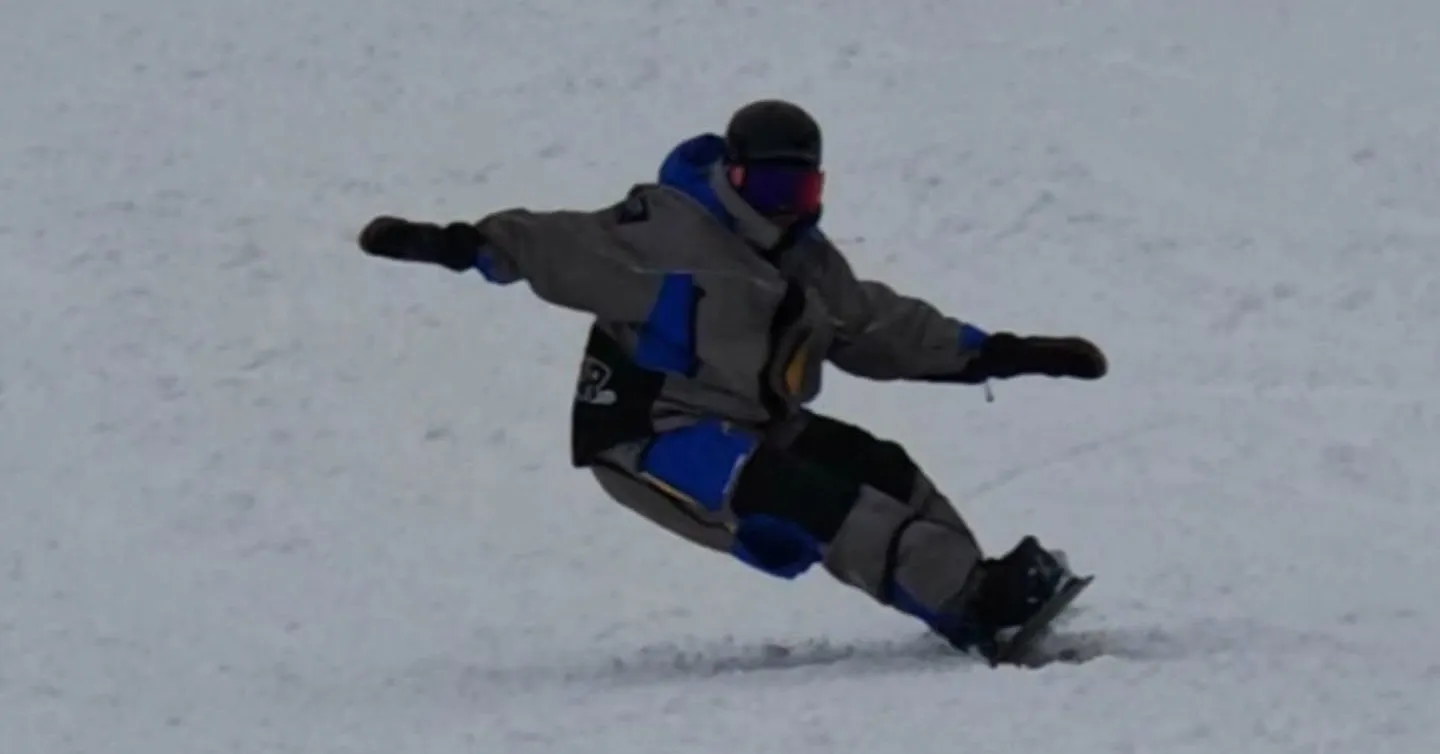
A thin pencil line is a result a carve may leave behind, not the test. Soft snow, loose snow, speed, edge angle and load can all make the board cut, compress and throw out a lot of snow. Spray only proves that snow was pushed aside; it does not mean the board is sliding sideways.

KAKU sums the test up in three lines:
- Lots of spray does not necessarily mean you are skidding
- A wide track does not necessarily mean it is not a carve
- Look at the deviation between where the board points and the direction it is actually moving
Carving is after low slide, not zero slide. A carve is judged by the relationship of motion, not by visual perfectionism.
KAKU
Snow conditions follow the same logic. “Carving only works on good snow; once the snow turns bad it’s useless” is a claim KAKU has never accepted. On firm, smooth snow the movements can be big and fast. On soft, uneven snow, more depends on how well the legs adjust, and on how edging, loading and the timing of the edge change work together.
“Bad snow does make it harder,” KAKU also says, “but it shouldn’t become an excuse that covers up gaps in technique.” There is also footage of KAKU riding moguls and uneven terrain, filmed in reply to the claim that “JSBA can only carve and can’t ride complex terrain”.
Key point: a thin track and little spray are results. The judgement has to come back to the relationship between the board and its direction of travel.
Slide angle: how the edge bites the snow
The test KAKU uses is called the slide angle (Japanese スライドアングル, suraido anguru): the angle between the board’s long axis and its actual direction of travel.
- The angle stays large and the board is visibly pushed sideways: skidding.
- The angle is very small and the nose points almost along the path of travel: even if the track has width and depth, and snow sprays from under the board, it can still be a carve.
KAKU’s account is that JSBA teaching materials have always separated skidding from carving by the amount of slide: a carve slides less, with less resistance and less deceleration in it. The materials do not require a carve to have zero slide from start to finish; a little sideways slip does not stop a turn counting as a carve.
KAKU gives no figure for “how many degrees or less counts as carving”, and neither does this post.
On the research side, a 2022 study by Debertin and colleagues compared sensor data from parallel turns and carved turns; it is a proof of concept. Its limits need stating plainly: the participants were certified instructors, the discipline was skiing, the data came from wearable sensors, and the study did not measure slide angle. It cannot be used to set a standard for snowboard carving.
Key point: what you look at is the angle between the board’s long axis and its direction of travel. Carving seeks low slide, not zero slide.
What this series works on next
With the test clear, Carving Lab moves on to taking the movements apart. The next part covers the toeside: lock the ankle, don’t kneel into the boot tongue.
If you first want to know where carving came from and why it evolved toward soft boots, read Part 1 of Three JSBA Conversations; that post covers the origins, this one covers the test. For Japanese terms, see the Chinese–Japanese snowboard glossary (in Chinese).
Who this post is not for
- Riders who cannot yet link turns consistently: get your edge changes solid first; you won’t need the carving test yet. Read the fake weight shift post in Snowboarding: Your First Week.
- Anyone looking for a standard answer to “how many degrees counts as a carve”: KAKU has not given one, and this post does not make one up.
To take a carving lesson in Hokkaido, see the Snowboard Progression Lesson on the courses page. If you are not in Hokkaido, see the online courses. KAKU’s qualifications are on the principal’s profile.
The test in this post is compiled from KAKU's Threads posts of August and October 2026. The video is from an October 2026 post, with the audio track removed; the cover photo is from a November 2025 post. The research section cites only conclusions stated in the paper's abstract.
Sources
- https://www.threads.com/@kakukazui/post/Db0zJSeD-S2
- https://www.threads.com/@kakukazui/post/De_u-9OD-Cv
- https://www.threads.com/@kakukazui/post/DQn4kHID2ts
- https://www.threads.com/@kakukazui/post/DRCNrZegdu7
- Daniel Debertin, F. Wachholz, R. Mikut, Peter A. Federolf (2022). Quantitative downhill skiing technique analysis according to ski instruction curricula: A proof-of-concept study applying principal component analysis on wearable sensor data. https://www.semanticscholar.org/paper/548cce0a4e4f0a035ff4b01921270ee1d4bde0d3
Data on this site used here
A few common questions
What is the difference between carving and skidding?
KAKU's test is the slide angle: the angle between the board's long axis and its actual direction of travel. A large, sustained angle with the board pushed visibly sideways is skidding; a very small angle, the nose pointing almost along the path, is carving.
If my track is a thin line, am I carving?
In KAKU's view, a thin pencil line is a result, not the test. Soft snow, loose snow, speed, edge angle and load can all make the board cut through and throw out a lot of snow; a track with width, and spray from under the board, can still be a carve.
Can you carve in rough snow?
KAKU says yes. Soft, uneven snow asks more of leg adjustment and of how edging, loading and edge-change timing work together; the movements look smaller, but the carve can keep its quality. KAKU also concedes that bad snow makes it harder.
When am I ready to start learning to carve?
SnowWind's Snowboard Progression Lesson requires that you can already link turns consistently. If you are still working on linked turns, start with the Beginner Lesson. What each course covers is on the courses page.
Related articles
MoreWhat are the fundamentals of snowboard carving? Five elements, and stepping back a level first
Stuck carving? KAKU: step back a level. Five elements: pressure, edging, rotation, lean, angulation. Low stance hinges on angulation; touching snow is a result.
Read →Snowboard carving like squatting on a toilet? How open hips and angulation work together
Sitting back, butt out? Often, KAKU says, open hips and angulation aren't working together: hips steer, angulation stabilises; hips first. With 西西's drill.
Read →Do you need to learn duck stance first for snowboard carving? Duck vs forward stance trade-offs
KAKU's view: duck and forward stance don't rank, and neither has to come first. What each does well, what it costs, and whether JSBA exams set an angle.
Read →Want to go further?
SnowWind offers beginner and progression lessons — from your first turn to advanced carving. Lessons in Mandarin and English; a Cantonese-speaking coach for the Beginner Lesson.
Prices & booking